> For the complete documentation index, see [llms.txt](https://docs.cartographer3d.com/llms.txt). Markdown versions of documentation pages are available by appending `.md` to page URLs; this page is available as [Markdown](https://docs.cartographer3d.com/cartographer-probe/installation-and-setup/probe-installation/can-termination.md).
# CAN Termination
### CAN Probe termination status
Probe
Default Status
Cartographer V2 CAN (primarily sold pre-2024)
Disabled
Cartographer V3 USB/CAN with lis2dw*
Enabled
Cartographer V3 USB/CAN with ADXL345
Disabled
Cartographer V4 USB/CAN
Disabled
{% hint style="warning" %}
Do **NOT** measure your resistance while the probe is powered on.\
\
On the Cartographer V3 USB/CAN with lis2dw probe, for the 120ohm resistor to be activated it has to be powered on, and flashed with the CAN firmware. That means that you will not be able to measure if your can lines are at 60 ohms.\
\
If you measure them (while the probe is powered off) and you get 60ohms, that means you have too many 120ohm terminations in your CAN network.
{% endhint %}
### Cartographer w/ Input Shaper (v2)
There are many differing opinions on where and how to terminate your CANBUS setup, if you want to fully meet with spec, you are supposed to terminate on the last device in the chain.\
\
When setting up your probe, this is fairly difficult to do, in this case it can purely be treated like a spur, and you can terminate on your toolhead. With this method, we have not seen any detremental performance or issues.
IF you want to terminate on your Cartographer, this requires two solder points to be bridged together (see below)
### **Cartographer V3 w/ Input Shaper with lis2dw (USB/CAN Hybrid)**
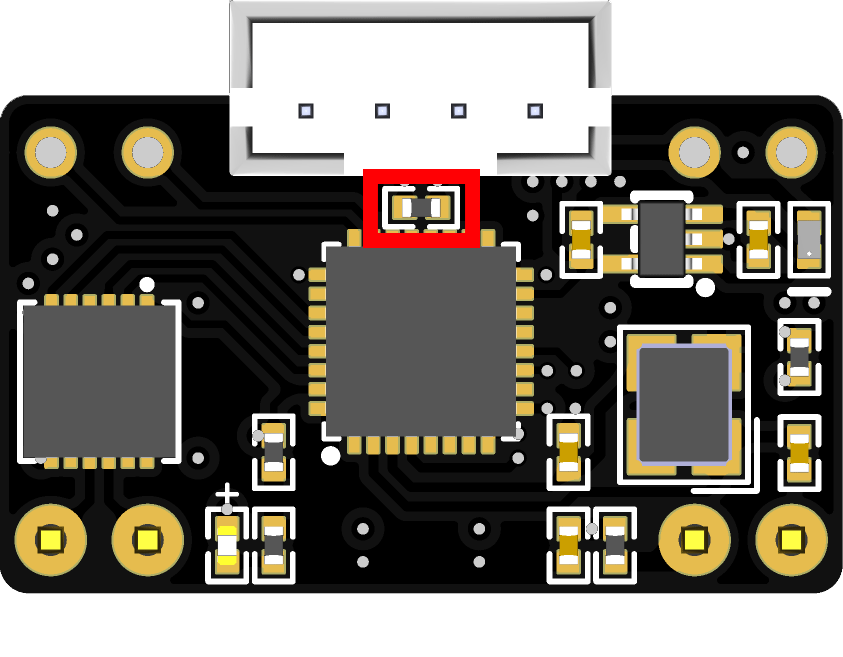
This version of the probe is terminated with a 120ohm resistor by default when in CAN mode. if you want to remove the 120 Ohm resistor, use a soldering iron to remove the resistor that can be seen below.
### **Cartographer V3 w/ Input Shaper with ADXL345 (USB/CAN Hybrid)**
With the ADXL version of the probe, we were not able to enable the pre-terminated 120ohm resistor due to the change and implementation of a higher temperature rated multiplexer.
Terminating on the probe is not essential, and we have hundreds of users who terminate on their toolhead with no detrimental issues.
{% hint style="danger" %}
If you enable the 120 Ohm resistor, you will not be able to use the probe in USB mode, this also means to reflash the probe you will be limited to Katapult mode or using a STLink.
{% endhint %}
If you want to terminate on your Cartographer V3 ADXL, this requires the three solder points to be bridged together (see anotated below).
### **Cartographer V4 w/ Input Shaper with ADXL345 (USB/CAN Hybrid)**
As with the Cartographer V3, the V4 version of the probe, we were not able to enable the pre-terminated 120ohm resistor due to the change and implementation of a higher temperature rated multiplexer.
Terminating on the probe is not essential, and we have hundreds of users who terminate on their toolhead with no detrimental issues.
If you want to terminate on your Cartographer V4, this requires the solder points to be bridged together (see anotated below).
---
# Agent Instructions
This documentation is published with GitBook. GitBook is the documentation platform designed so that both humans and AI agents can read, navigate, and reason over technical content effectively. Learn more at gitbook.com.
## Querying This Documentation
If you need additional information that is not directly available in this page, you can query the documentation by asking a question.
Perform an HTTP GET request on the following URL with the `ask` and `goal` query parameters:
```
GET https://docs.cartographer3d.com/cartographer-probe/installation-and-setup/probe-installation/can-termination.md?ask=&goal=
```
`ask` is the immediate question: it should be specific, self-contained, and written in natural language.
`goal` is what the user is ultimately trying to achieve, the reason they need the answer. Sharing it helps GitBook give you a better, more relevant answer. A goal is most helpful when it describes the outcome the user wants rather than restating the question. For example, with `ask=how do I create an API token`, a goal like `automate deployments from our CI pipeline` lets GitBook tailor the answer to that use case.
The response will contain a direct answer to the question and relevant excerpts and sources from the documentation.
Use this mechanism when the answer is not explicitly present in the current page, you need clarification or additional context, or you want to retrieve related documentation sections.