

Troubleshooting
This list is not exhaustive. If your problem is not here, or the fix does not work, come and talk to us on Discord. If you think something is missing from this page, let us know and we will add it.
Unless an entry says otherwise, it applies to the current Cartographer plugin (the one with [mcu cartographer] and [cartographer] sections). If your config has a [scanner] section, see Which version do I have?
Before you ask for help
Section titled “Before you ask for help”Create a thread in the Help & Support section on Discord and include:
- your
printer.cfg, - your
klippy.log, - screenshots of the issue if available, and
- a description of what you were doing when it happened.
If you are getting inconsistent touch results or touch failures, check these first:
- Is the probe mounted 2.6 to 3 mm above the nozzle tip? See mounting.
- Is the toolhead completely rigid? Check for loose screws.
- Is the wiring sound, with no intermittent connections?
- Are the A/B or X/Y belts and the Z belts or lead screws in good order and correctly tensioned?
- Is the nozzle clean?
- Have you tried disabling Crowsnest, adaptive meshing (KAMP), and LED effects?
Installation and configuration errors
Section titled “Installation and configuration errors”Command Mismatch
Section titled “Command Mismatch”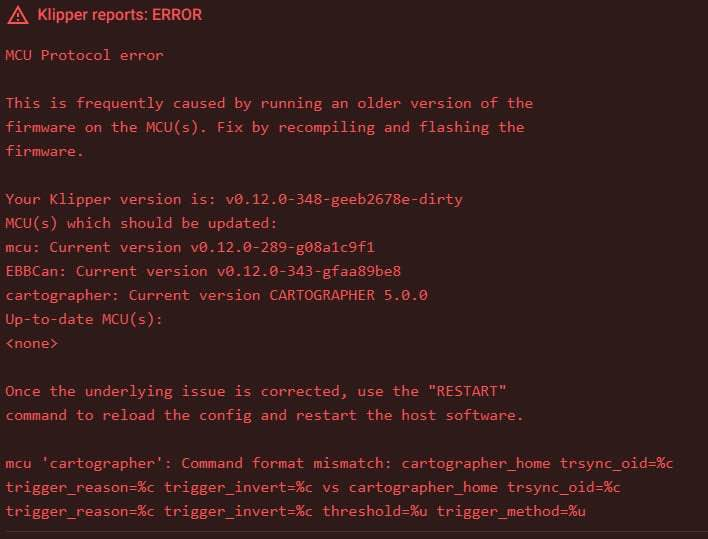
The firmware on the probe and the plugin in Klipper are from different generations, for example newer firmware with the old [scanner] plugin, or Survey 5.x firmware with the original [cartographer] plugin.
The fix is to bring both up to date together. Note your x_offset and y_offset, then follow Klipper Setup to install the current plugin (its first step covers removing the old [scanner] config), and Updating Firmware to update the probe.
If you are deliberately staying on the older [scanner] plugin, follow the old configuration guide instead.
Option ‘pin’ in section ‘probe’ must be specified
Section titled “Option ‘pin’ in section ‘probe’ must be specified”
Klipper cannot find the plugin. This happens after a Klipper update occasionally breaks the symlink, or if the Klipper component was not installed. Either way, re-run the installer:
curl -s -L https://raw.githubusercontent.com/Cartographer3D/cartographer3d-plugin/refs/heads/main/scripts/install.sh | bash -s -- --klipper ~/klipper --klippy-env ~/klippy-envUnknown pin chip name ‘cartographer’
Section titled “Unknown pin chip name ‘cartographer’”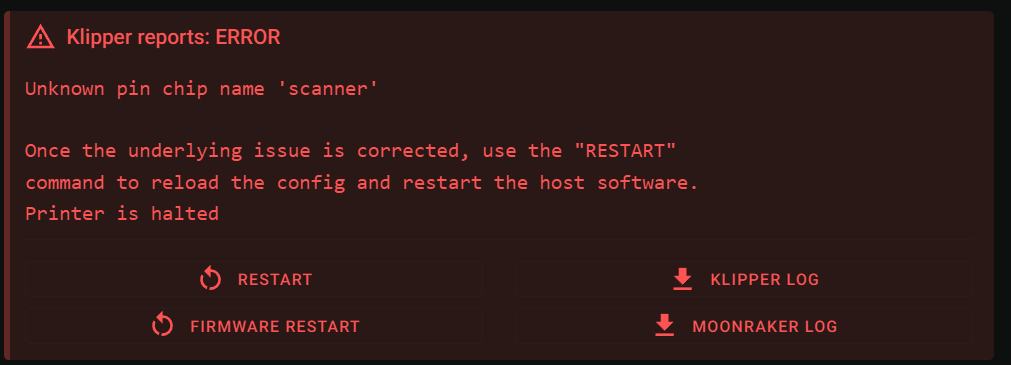
The usual causes are:
- You reference the probe before declaring it. Place the
[mcu cartographer]and[cartographer]sections near the top ofprinter.cfg, just after your other[mcu]sections. - A capitalisation mismatch, for example
cs_pin: Cartographer:PA3instead ofcs_pin: cartographer:PA3. Section and pin names are case-sensitive.
It can also mean the link between Klipper and the plugin is broken. Check the symlinks:
find ~/klipper/klippy/extras/ -maxdepth 1 -type l -lsIf they look wrong, or you are unsure, re-run the installer and check again:
curl -s -L https://raw.githubusercontent.com/Cartographer3D/cartographer3d-plugin/refs/heads/main/scripts/install.sh | bash -s -- --klipper ~/klipper --klippy-env ~/klippy-envUnknown pin chip name ‘probe’
Section titled “Unknown pin chip name ‘probe’”
Your [cartographer] section is below [stepper_z], which references probe:z_virtual_endstop. Move [mcu cartographer] and [cartographer] up, near your other [mcu] sections.
mcu ‘cartographer’: Unknown command: endstop_home
Section titled “mcu ‘cartographer’: Unknown command: endstop_home”In [stepper_z] you have endstop_pin: scanner:z_virtual_endstop or cartographer:z_virtual_endstop. It should be endstop_pin: probe:z_virtual_endstop.
Unable to parse option mesh_runs in section cartographer
Section titled “Unable to parse option mesh_runs in section cartographer”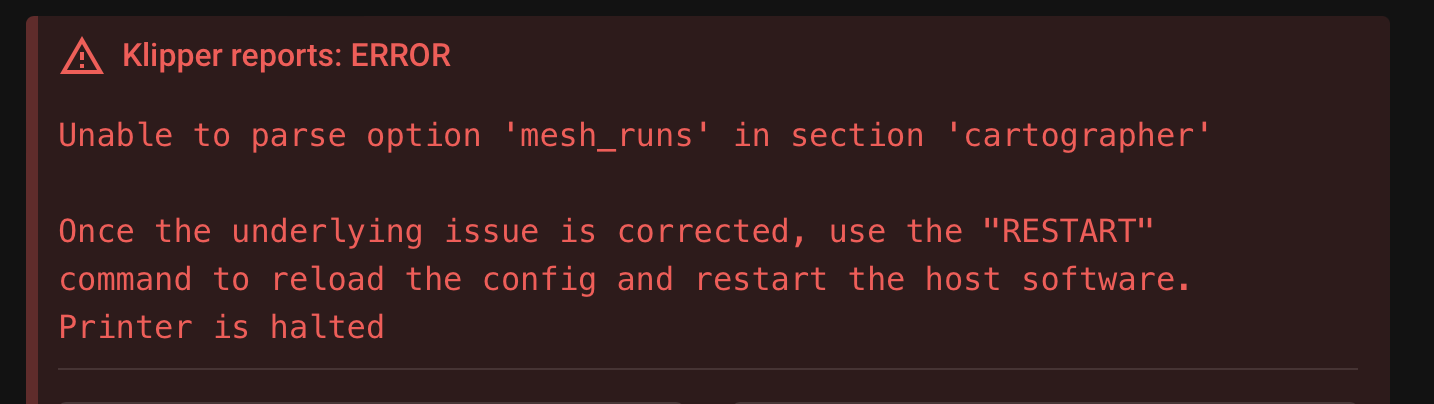
In the current plugin mesh_runs belongs in the [cartographer scan] section, not [cartographer]. See the Configuration Reference. (In the original plugin it was a top-level [cartographer] option, which is where old example configs put it.)
Option mesh_main_direction is not valid
Section titled “Option mesh_main_direction is not valid”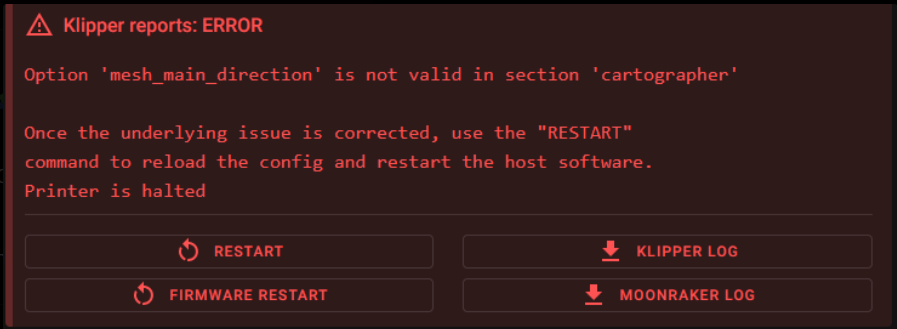
mesh_main_direction is a key from the previous [scanner] plugin. In the current plugin the key is mesh_direction in the [cartographer scan] section.
Scanner model ‘default’ was created for x (previous plugin)
Section titled “Scanner model ‘default’ was created for x (previous plugin)”On the previous [scanner] plugin, this means the saved model does not match the current mode. Recalibrate so a new model is created for the mode you are using.
Klipper is showing my install as dirty
Section titled “Klipper is showing my install as dirty”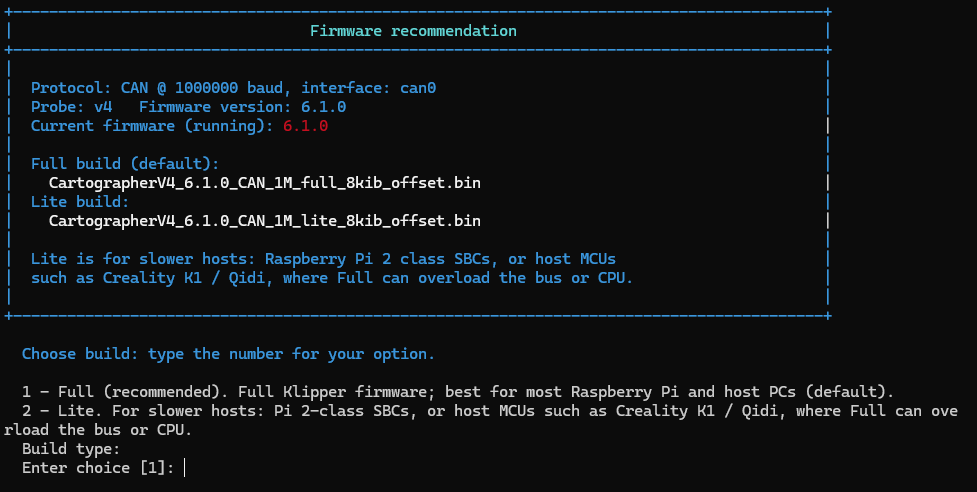
Klipper marks its build as “dirty” when there are untracked Python files in its folders. Any plugin that adds files to Klipper causes this, including Shake&Tune and LED Effects. It is expected and does not affect anything. Do not press “clean” or “recover” to get rid of it.
Weird errors after updating the plugin
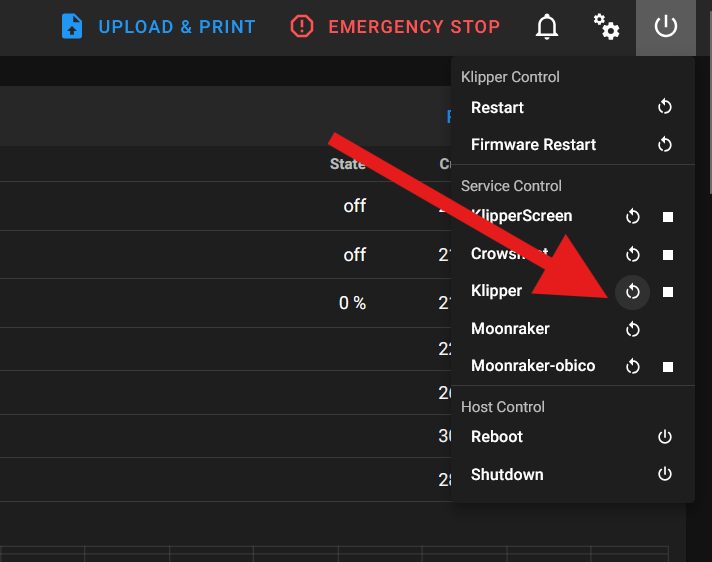
Section titled “Weird errors after updating the plugin”Press RESTART KLIPPER in Fluidd or Mainsail after any plugin update. Until you do, Klipper is still running the old version.
Connection and firmware
Section titled “Connection and firmware”Cannot find the probe in ls /dev/serial/by-id/
Section titled “Cannot find the probe in ls /dev/serial/by-id/”There are a few possible causes.
A udev bug on Debian Bullseye (which includes older MainsailOS and, since May 2023, some Raspberry Pi OS images) stops the symlinks in /dev/serial/by-id/ from being created. Check your udev version with apt show udev. If it is 247.3-7+deb11u2 or 247.3-7+rpi1+deb11u2 (note the trailing u2), replace the rules file with the upstream one:
# back up the existing rules filesudo cp /usr/lib/udev/rules.d/60-serial.rules /usr/lib/udev/rules.d/60-serial.old# download the rule from the systemd repositorysudo wget -O /usr/lib/udev/rules.d/60-serial.rules https://raw.githubusercontent.com/systemd/systemd/main/rules.d/60-serial.rulessudo rebootThe probe is flashed for CAN. A V3 can be flashed for either protocol. If it has CAN firmware it will not appear on USB. See Switching Protocols or, if it is unresponsive, Recovery via DFU.
The USB cable. If you assembled a flat pack in the Right Angle orientation, the USB cable may need to be re-pinned in reverse. See Wiring Diagrams.
Endstop Z showing triggered all the time
Section titled “Endstop Z showing triggered all the time”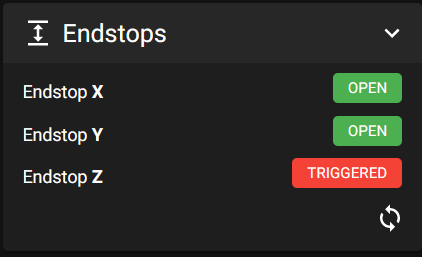
With a scanning probe the Z endstop is “triggered” whenever the probe reads closer than its trigger height. If it is always triggered even when the toolhead is high, the probe has not been calibrated yet. Run scan calibration.
Error importing numpy: you should not try to import numpy from…
Section titled “Error importing numpy: you should not try to import numpy from…”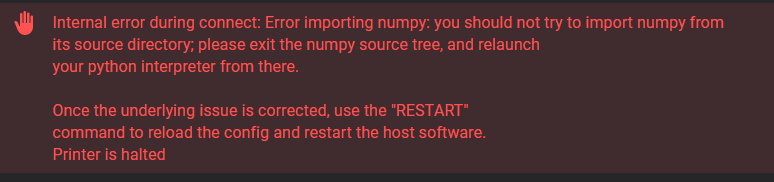
This usually happens when the plugin was installed as root rather than as your normal user. Update Klipper to the latest version through the web interface or KIAUH, then connect via SSH and run:
sudo apt install libopenblas-baseIf that package is not available (newer Debian releases), try:
sudo apt install libopenblas-devKlipper environment running on Python 2
Section titled “Klipper environment running on Python 2”The plugin needs Python 3.9 or later. Migrate your Klipper environment to Python 3. The steps below are from the Klipper Discourse guide; EricZimmerman’s OS upgrade guide is also worth reading.
sudo service klipper stop
# remove the current klippy-env environmentcd ~rm -rf klippy-env
# create a new venvvirtualenv -p python3 klippy-env
# install the Klipper requirements into itcd ~/klippy-envbin/pip install -r ../klipper/scripts/klippy-requirements.txt
Restart the printer and you should have a Klipper environment running on Python 3.
Probing and bed mesh
Section titled “Probing and bed mesh”Strange bed mesh or touch results
Section titled “Strange bed mesh or touch results”Disable any custom macros that wrap BED_MESH_CALIBRATE or change the gcode Z offset, such as KAMP adaptive meshing, and try again. Also try disabling Crowsnest and LED effects, which can load the host enough to disturb probing.
Missing clusters or a sharp drop in the bed mesh
Section titled “Missing clusters or a sharp drop in the bed mesh”The probe is reading off the edge of the bed, or over a hole or magnet, at some mesh points. Remember the coil is offset from the nozzle by x_offset and y_offset. Reduce mesh_min and mesh_max in [bed_mesh] so that the coil stays over metal at every point.
No trigger on z after full movement
Section titled “No trigger on z after full movement”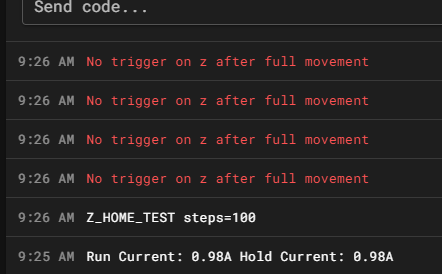
If this repeats and you are running a lower-powered host such as a Raspberry Pi 2 or a BTT CB1, the host is not keeping up. You can pin Klipper to a single CPU core; Esoterical has a guide. Switching to Lite firmware also reduces the load.
Klipper freezes during a scan, or “timer too close”
Section titled “Klipper freezes during a scan, or “timer too close””The probe sends a lot of data during a scan. If the host is too busy, Klipper can freeze or report timer too close. This is usually an underpowered host such as a Raspberry Pi 2 or 3 or a BTT CB1. Try disabling cameras and other intensive processes, switch to Lite firmware, or follow Esoterical’s guide. If all else fails, a more powerful host is the fix.